

What Is Underwater Rugby? Rules, History, Equipment & Why Athletes Are Obsessed With It
At first glance, underwater rugby sounds impossible. Two teams of six players, no air, diving to the bottom of a pool to score a sinking ball into a metal basket — all while holding their breath. Yet underwater rugby is a real, internationally played competitive sport with official rules, national leagues, world championships, and a fiercely loyal global community. This guide covers everything you need to know: what underwater rugby is, how it's played, where it came from, and what equipment you need to play.
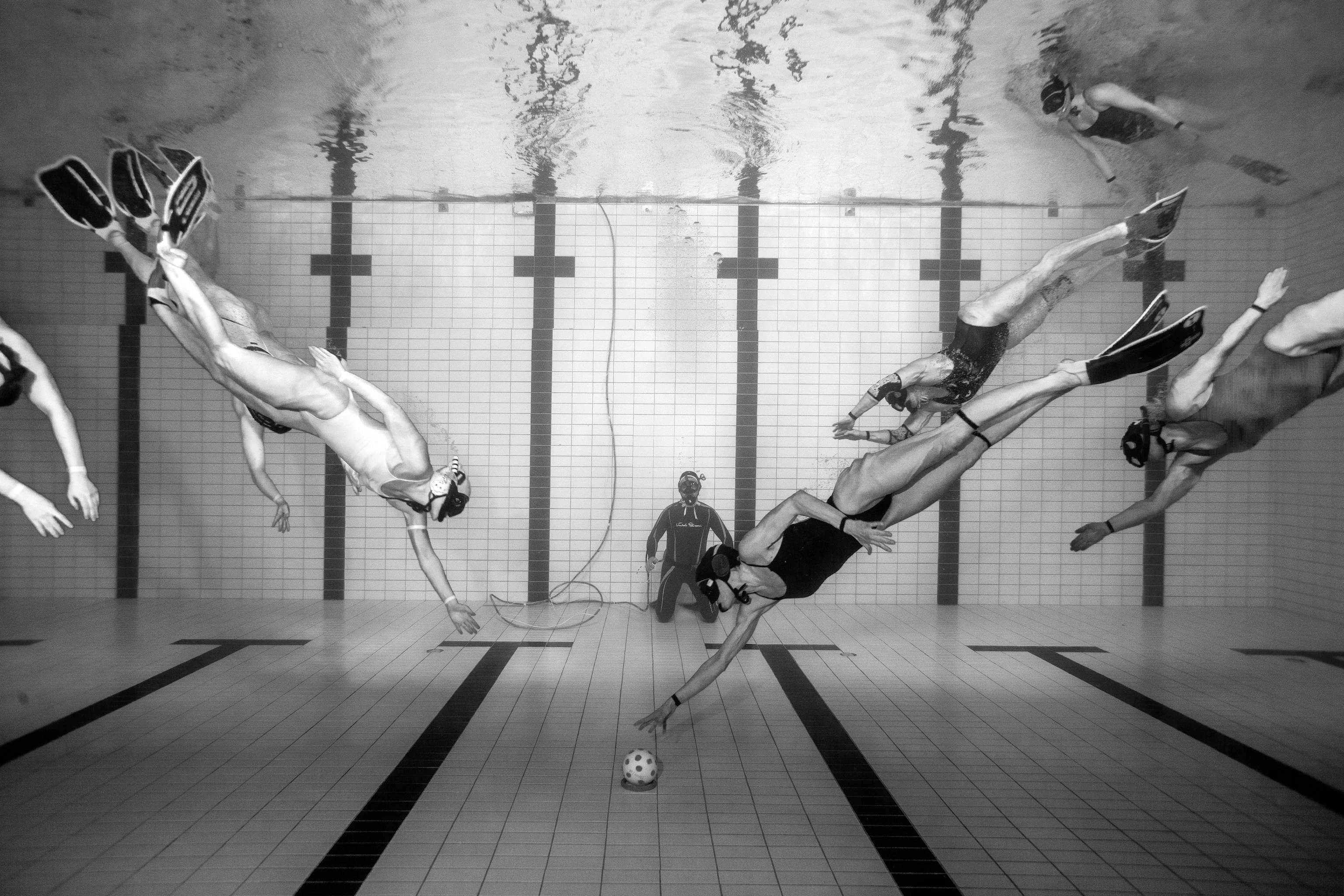
What Is Underwater Rugby?
Underwater rugby is a breath-hold team sport played entirely beneath the surface of a swimming pool. Two teams of six active players compete to place a negatively buoyant ball — one that sinks — into a metal basket fixed to the pool floor, typically at a depth of 3 to 5 metres.
Unlike any other team sport, the playing field is fully three-dimensional. Players attack and defend from above, below, and every side. There is no flat pitch, no lines on the floor, and no referee's whistle — only the pool, the ball, and the players competing in complete silence beneath the surface.
- Teams: 6 players per side in the water at any time, with substitutes rotating constantly
- Objective: place the negatively buoyant ball into the opposing team's submerged basket
- Pool depth: 3–5 metres for the playing area
- Equipment: fins, mask, snorkel, and water polo-style cap — no breathing apparatus
- Contact: physical contact is allowed, but only against the player in possession of the ball
- Referees: monitor from above and below water, signalling with hand gestures — no whistles
History of Underwater Rugby — How It Started
Underwater rugby did not emerge from a grand sporting vision — it began in the 1960s in Germany as a training exercise for divers. Underwater athletes needed a way to build strength, breath control, and team coordination beneath the surface. Someone introduced a ball, a set of goals, and a competitive format — and within years, what started as a conditioning drill evolved into a sport of its own.
Formal rules were codified, clubs formed, and international competitions followed. Today, underwater rugby is governed by CMAS (Confédération Mondiale des Activités Subaquatiques) and is played competitively across Europe, the Americas, Asia, and beyond. The fact that a serious global sport grew directly out of a niche training drill only adds to its remarkable story.
|
📅 Underwater Rugby Timeline
|
How Is Underwater Rugby Played? The Rules Explained
To someone watching for the first time, the rules appear simple: put the ball in the basket. But the details reveal a surprisingly complex and tactical game.
Core Rules
- Physical contact is allowed only against the ball carrier — you cannot tackle or interfere with players not in possession
- No timeouts — the game continues underwater with no formal pauses
- Substitutions are constant — players rotate in and out because no one can stay underwater indefinitely
- The ball sinks — players cannot simply float and hold it; possession must be fought for at depth
- Fouls are resolved quickly, often without stopping the game entirely
- Referees use hand signals only — there are no audible whistles underwater
The 3D Dimension — What Makes It Unlike Any Other Sport
Traditional sports are played on a flat, two-dimensional surface. Underwater rugby is played in a fully three-dimensional space. Defending a goal means protecting it from all directions — including directly above. Attacking means coordinating dives, passes, and retreats while managing oxygen as a limited, strategic resource.
This creates tactical complexity that no surface sport can replicate. Players must think in three dimensions, time their dives precisely, and trust teammates to cover positions when they surface for air — all in complete silence.
How Physically Demanding Is Underwater Rugby?
Despite its unusual appearance, underwater rugby is one of the most physically demanding sports in existence. Players must combine cardiovascular endurance, muscular strength, flexibility, breath-hold capacity, and mental composure — simultaneously, under physical contact, at the bottom of a pool.
🏊 Swimming Endurance
High-volume pool training to build the aerobic base needed to sustain repeated deep dives throughout a match.
🫁 Apnea Training
Static and dynamic breath-hold training to maximise time underwater and improve oxygen efficiency under physical stress.
💪 Strength Conditioning
Core and upper body strength to control the ball, hold position at depth, and handle physical contact in a three-dimensional environment.
🧠 Tactical Drills
Rotation patterns, positional drills, and set plays developed entirely through hand signals and pre-rehearsed team coordination.
|
⚠️ Oxygen Management Is Everything The best UW rugby players are not those who can hold their breath the longest — they are those who know exactly when to dive and when to retreat. Staying underwater too long risks exhaustion or blackout. Surfacing too early leaves your team exposed. Mastering this timing is what separates good players from elite ones. |
Teamwork in Underwater Rugby — A Level Above Any Other Sport
If teamwork is important in traditional sports, it is absolutely critical in underwater rugby. No player can operate independently. Every dive must be supported by teammates above and below. Players rotate constantly — one group attacks while another recovers at the surface, ready to replace them on command.
Communication happens entirely through gestures, eye contact, and rehearsed patterns. There is no time for discussion once underwater. This creates a level of trust rarely seen in other sports — you rely on your teammates not just to win, but to keep you safe.
Ask any underwater rugby player why they play, and you rarely hear the word "weird." Instead they use words like intensity, focus, addiction, and clarity. The sport demands complete presence. There is no room for distraction underwater — and that forced mindfulness is one of the most powerful things the sport delivers.
Underwater Rugby Equipment — What You Need to Play
Underwater rugby uses purpose-built gear designed to maximise performance, safety, and durability under the physical demands of contact play.
Fins — The Single Most Important Piece of Equipment
Your fins determine your speed, agility, and propulsion in every single dive. The difference between rubber and fiberglass fins in underwater rugby is not marginal — fiberglass fins are significantly faster than any rubber fin. At competitive level, that speed advantage is decisive.
|
🏆 The Best Fins for Underwater Rugby — By Far Fiberglass fins outperform every rubber fin on the market for speed and propulsion. These are the fins used by top competitive UW rugby players worldwide:
|
Rubber Fins — A Solid Secondary Choice
If you are just starting out in underwater rugby, or looking for a more affordable entry point, natural rubber fins are a legitimate and durable option. They are CMAS homologated, competition legal, and used by players at all levels. They simply cannot match the outright speed of fiberglass blades at elite level.
- Powerfins — maximum propulsion per kick among rubber fins; best rubber option for UW rugby
- Najade Speed — medium stiffness, excellent all-round performance for rugby and hockey
- Murena Fins — great value, available in 4 colours for team kits
Note: Najade Iron is not recommended for UW rugby — the blade is too stiff for the agility demands of the sport.
Mask
A low-volume freediving or UW sports mask. Low volume means less air to equalise, less drag, and a closer fit that stays secure during physical contact.
Snorkel
A simple, flexible freediving snorkel without a complicated purge valve. J-shaped snorkels are preferred by most UW rugby players for their reliability during contact.
Cap
Water polo-style ear protection caps — worn to protect the ears during contact and identify teams by colour.
Browse all fins for Underwater Rugby and Hockey at SpearfisherShop →
Why Do Athletes Love Underwater Rugby?
Because underwater rugby is relatively unknown compared to mainstream sports, it attracts a tight-knit, passionate global community. Competitions feel less like commercial sporting events and more like gatherings of a global underground culture. For many players, the fact that the sport is misunderstood is part of its appeal.
The mental clarity the sport delivers is unlike anything else. The moment you dive, everything else disappears — there is only the water, your lungs, and the game. Players consistently describe it as deeply meditative, intensely physical, and completely addictive.
Unlike many sports shaped by entertainment value and commercial pressure, underwater rugby exists purely because those who play it love it. That authenticity is rare — and it's exactly why the community keeps growing.
Underwater Rugby FAQ
Is underwater rugby an Olympic sport?
Not currently. Underwater rugby is governed by CMAS and has its own World Championship, but has not yet been included in the Olympic programme. Interest continues to grow internationally.
How deep is the pool in underwater rugby?
Competition pools are typically 3 to 5 metres deep. The goals (metal baskets) are fixed to the pool floor, so all scoring happens at maximum depth.
How many players are on an underwater rugby team?
Six players per team are active in the water at any time, with multiple substitutes rotating constantly throughout the match.
What is the ball made of in underwater rugby?
The ball is negatively buoyant — it sinks. Typically salt-water filled to achieve the correct density. Possession must be fought for at the bottom of the pool, not at the surface.
Where can I play underwater rugby?
Clubs exist across Europe, North America, South America, and parts of Asia. Search for your national underwater sports federation (affiliated with CMAS) to find a club near you.
What fins are best for underwater rugby?
Fiberglass fins are the top choice — WaterWay Rugby Fins, WaterWay Nemo, WaterWay Nemo 2.0, and Ultrafins Short are significantly faster than any rubber fin. For a more affordable entry point, rubber fins like Powerfins or Najade Speed are a solid secondary choice.
|
Shop the Best Fins for Underwater Rugby From fiberglass competition fins to CMAS-approved rubber fins — everything ships worldwide from our EU and US warehouses. |